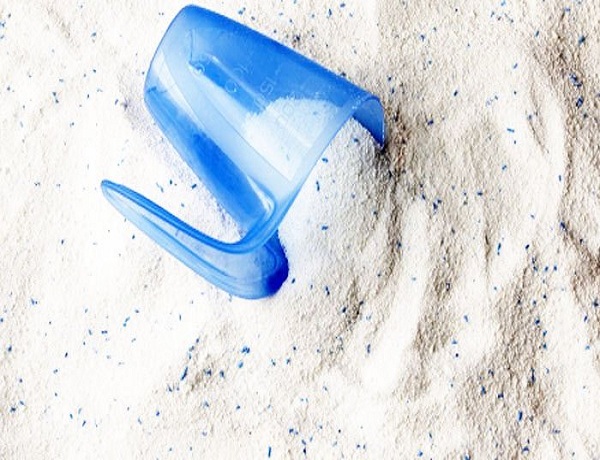
History of washing powders
SOAP AGE:
The need for cleanness, we would say today – hygiene, was already recognized in deep antiquity. Although there was no knowledge about microorganisms and their negative impact on human health caused by lack of hygiene, the ancients perceived the relationship between health and cleanness. This is confirmed by traces of clean water supply installations and sewerage systems.
An important role in improving the hygiene played Phoenicians, who found out around 5000 years ago that adding a mixture of vegetable ash (seaweed) and olive fat (olive oil) to water improved cleaning and washing properties. Today we know that soda contained in the ash saponified fats contained in olive oil and the product similar to soap that improved cleaning and washing process was created. This was the beginning of soap and soap industry, which played a significant role in improving human health and hygiene.
This technology was spreading thanks the Phoenicians, very busy merchants. At the beginning of our era, all the people of the Mediterranean were able to manufacture products similar to soap.
Real soap, the so-called “hard soap” was created in the eighth century AD in the Middle East. The Arabs developed its productions in the Mediterranean. During the middle Ages, the production was located in Marseille, Genoa, Venice and Spain; in places where olive fat, soda from seaweed ash and Arab influences existed. And this is where the names “Marseille soap” and “Castilian soap” come from.
Popularization and cheapening of soap was at the end of the eighteenth century, when French chemist Leblanc developed a technology of obtaining synthetic soda. It accelerated the development of soap trade. Soap became a common commodity. In 1884, the first soap bar called “Sunlight Soap” was introduced to the market, and it was manufactured by the Lever Brothers plant at Port Sunlight in the amount of 450 tons per week.
The true intellectual washing adventure began only in the twentieth century.
TWENTIETH CENTURY, ERA OF WASHING POWDERS:
The development of sciences, especially in the twentieth century made it clear how complex physicochemical process was the process of washing. It was found that the condition for good wash is meeting by the washing detergent many, often conflicting conditions. A good detergent should:
- Reduce the surface tension of water, which determines good wetting of fibre and emulsification of fat being an ingredient of dirt
- Disperse pigment from dirt (move dust particles from fabrics into the wash)
- Create protective colloid, i.e. prevent re-deposition of pigment from dirt on the fibre surface, which results in fabrics turning grey
- Soften water, which reduces incrustation (precipitation of limescale inside fibres) and increases the effectiveness of surfactants;
- Provide alkaline reserve in the wash, which improves the effectiveness of removing dirt.
The first technological breakthrough came in 1907. The era of washing powders began, the first genuine washing powder with chemical bleaching function was developed. Consumers were freed from the need for onerous bleaching of fabrics. In 1913, first washing powders containing enzymes for soaking were introduced to the market. In the 1930s, “dethronement” of natural soap and soda began – the era of synthetic detergents (in other words surfactants) called at that time synthetic soap came. In the 1940s, phosphates were used to soften water more efficiently than soda and improve washing results, as well as optical brighteners that replaced the ultramarine as an agent for improving shade of white. Next decades brought new ideas and discoveries that improved the comfort of washing. Massification of production favoured lower prices and widespread availability of washing powders.
In 1990, worldwide production of detergents (without soap) amounted approximately to 7 million tonnes, while washing powder to 12.7 million tonnes. Currently in Poland, annual consumption per household amounts to 17 kg, which is about 200 000 tonnes on the national level.
TWENTY FIRST CENTURY, ERA OF UNCONVENTIONAL SOLUTIONS:
The 1990s of the twentieth century was the period of first solutions based on the concentration of washing powders, which significantly reduced dose weight and volume used for washing. Standard packaging of concentrate contained more washing doses than traditional washing powders, the so-called “regular”. As technological experience was gained and research progressed, concentration of active ingredients was increased to the super-concentrated level, the so-called super concentrated or super compact washing detergents. In doing so, the problem of packaging waste was reduced. On the other hand, increased concentration of hazardous and noxious substances caused increasing risk of irritation to the consumer. Also, the use of the super compact washing powders increased the negative effects of overdosing.
At lionmak, we offer all chemical production lines , and to order our products, please contact us .